Origin Story
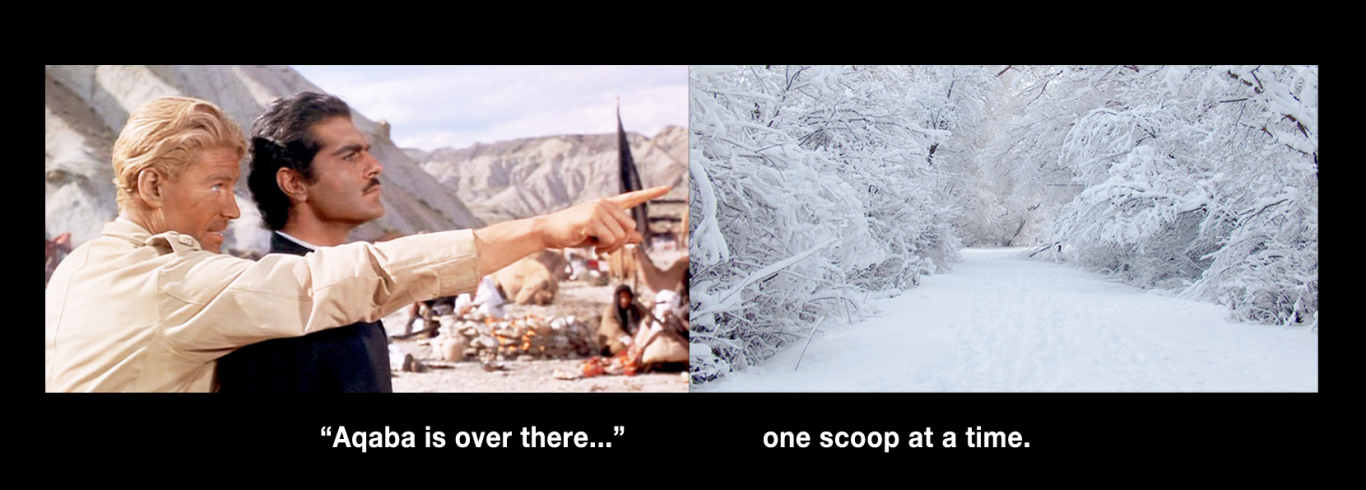
Inspiration comes to us from many sources. One powerful source for me was the film “Lawrence of Arabia,” the 1962 desert epic starring Peter O’Toole. In my favorite scene, Lawrence is trying to convince Prince Ali (played by Omar Sharif) to perform a much needed miracle by capturing the Gulf city of Aqaba. The miraculous part would be that Ali and his troops would have to cross the great Nefud Desert and arrive in Aqaba still strong enough to fight the Turks, who were garrisoned there and armed with modern weapons.
The Nefud, Ali protests, was a merciless wasteland without water or shade, relentlessly hostile to man and beast, and that to try to cross it would bring ruin to them all. Lawrence grabs Ali by the sleeve and drags him out of the tent into the open desert. Pointing at the horizon across the sand, he fixes Ali with a fierce glare and says, “Aqaba is over there. It's only a matter of going.”
It was the winter of 1994...
and I was living in a log cabin in the mountains about a mile off a narrow highway winding through the Rockies of southwest Colorado. It had snowed most of the previous day, and looking out the window, I saw my old Subaru wagon, a vaguely car-shaped bump in the winter landscape.
“Rats!” I thought, “I’ve got a gig this week.”
It was Sunday, and on Wednesday afternoon I was to be the solo pianist at The Peaks, a swanky resort hotel sixty miles and several icy mountain passes from my cabin. With my car bumper deep in snow, I thought of packing a bag, wading through the drifts to the main road and hitchhiking into town. Then I remembered Lawrence.
Twenty minutes later, bundled up in winter gear, my trusty grain shovel in hand, I started clearing a swath wide enough for the wagon. I knew I would have to be methodical, taking care not to hurt myself, but with three days and plenty of food and spring water, if I kept focused, I could shovel my way out before another storm stranded me for the winter. With any luck, my neighbor a quarter mile up the road might use his tractor to plow from his cabin to the highway. Then, I'd have only five hundred yards of actual shoveling between me and freedom.
I found a smooth technique: scoop, rock back, fling over the shoulder, step... scoop, rock, fling, step... scoop, rock, fling, step... By the end of the first day I'd cleared only enough snow to turn the car around and make it out to the gate thirty yards away. Drained and doubting my chances, I retreated to the cabin, eager for some dinner and a good night’s sleep.
The next morning was cold, clear, and glaringly bright, the sun reflecting off the snow-covered hillside; overhead was a dazzling electric Colorado-blue sky. I launched again into my Lawrencean (or so I fantasized) task with high spirits.
I kept at it all day Monday—scoop, rock, fling, step—and on Tuesday afternoon I busted through the six-foot-high plow wall at the back of my neighbor's property. Victory! High from endorphins and a sense of accomplishment, my upper body pumped like never before, I felt like a cartoon super-hero. With the shovel slung over my shoulder, I sauntered back up the road to the cabin.
“Aqaba is over there,” I reminded myself. “It’s only a matter of going.”
So what does this have to do with practicing piano?
Simply working the levers of the piano is one thing, but playing the instrument to move people on a profound, poetic, and emotional level... THAT’S going to take some work. It is doable if you have the desire, and commit to making it happen.
That experience is but one of many that suggest a different perspective about much of what we often dread as work. Answering a few simple questions is often all that’s needed to quell our anxieties and steel ourselves for so many seemingly daunting tasks:
- “Is it something we actually want to do?”
- “Do we have the time and resources to do it?”
When it comes down to it, the first question is really the only important one. When we can answer that, we’ll figure out the second part.
The Road Ahead
This is not a beginner’s book, but it does start at the beginning. It will teach you how to find your way around the keyboard and guide you to develop your daily practice. Although most of these exercises are fairly simple, I guarantee that if you practice them, your playing will improve dramatically.
This book is divided into two parts. In Part One, we delve into the shape and feel of the keyboard, intervals, and basic music theory. In Part Two, we apply those fundamentals to more sophisticated harmonic concepts and embark on an exploration of the art of improvisation. Along the way, we will ingrain these concepts through exercises that will build formidable technical prowess and deepen our sensitivity to the essential concepts of time, phrasing, feeling, and form.
The practice suggestions have two major benefits: they reinforce the core concepts, and they will strengthen your “chops” (technique). This patterned practice is the very heart of the method. You will train your hands and ears to navigate the keyboard without excess input from the analytical mind—you’ll have other things to think about besides how to spell a basic seventh chord.
This book does not boast to be a complete treatise on the subjects of jazz, theory, the piano, or practice. Those subjects are so broad that no single publication can honestly boast of being the “complete” anything in those areas. Nor does it claim to offer instant success, as in, “Learn to Play Like a Pro in Just [insert unrealistic number here] Days!” It just doesn’t work that way. If it did, there would be about a thousand new shredding beboppers every month. You cannot learn to play music simply by reading a book. You cannot learn to do any art just from a book. Art requires exposing yourself to multiple sources, lots of thinking, study, and solitude, and acquiring life experience. And lots of practice.
You Can Get There from Here
This book provides a path, a map if you will, of how to get there from here—“here” being where you are now and “there” being further down the road to excellence as an improvising musician. For some, that means being able to play anything, period. That’s certainly one way to look at it. A more practical and attainable goal might be to play a tune of your choice with some knowledge of the harmonic, melodic, and structural underpinnings so you can accommodate, through transposition and stylistic license, other players and voices into your musical world. In short, it means knowing what you are playing. It is not merely having something memorized, but includes the intuition and flexibility to express your creative energies spontaneously. This book points the way.
For the advanced student or professional with a basic knowledge of keyboard theory, and for those who already possess some facility as a result of a mainly classical curriculum, I strongly recommend you go through the first part of the book for two reasons:
1) Simple review. Even if you practiced scales ten years ago, chances are you aren’t practicing them anymore, or you haven’t practiced with the focus you will here.
2) The concepts discussed in Part Two depend on understanding the keyboard and scales in a tactile-intervallic context—the thrust of this book—which differs from the commonly taught rote approach.
For Beginners
If reading music is new to you, or you simply lack experience with jazz styles, you can nonetheless use these concepts to make fast progress at the keyboard. “Appendix I” contains the rudiments of music notation, along with the basics of interpreting the swing feel, but it can be frustrating to try this alone. Finding a qualified teacher is important (even Lawrence had a desert guide), and the task of finding one can be as simple as just asking around.
Check with a local college music department or local music store. One tip: a good teacher will play well. It stands to reason that someone who can’t actually swing is probably going to have a tough time teaching you how to, so if you have the chance, attend some local shows (if you're lucky enough to have a jazz scene in or near your city) and hear if the players sound like they know what they are doing. Ask them if they teach. (If they themselves don’t teach, they will likely be able to recommend someone they respect.) You can also get a feel for their personality by watching them on the gig. Having some level of comfort with a teacher’s demeanor is essential to successful lessons.
Even if you live in “the sticks,” like, say, eight hours from a sizeable city, you can probably still find a teacher to help guide you while you get the basics under your belt, whether they appreciate jazz or not. And, for what it's worth, I've lived off and on for many years in small rural communities, so just keep your ears open.
The Promise
Follow the suggestions in this book, and your playing will improve. It’s as simple as that. You will develop an intuition about soloing and playing with others that you may have only dreamed about, and you will open creative doors that you didn’t even know were there. I’ve taught others how to do it, and if you travel this road with me, you will do it too. It’s only a matter of going.